


Stakeholders give FG 6-month ultimatum for port community system, 31-gunboat security, host community revenue share as AfCFTA pressure mounts
Felix Mbata, Lagos state
 Nigeria’s maritime sector closed ranks Wednesday at Rockview Hotel, Apapa, with regulators, security chiefs, lawmakers and policy experts agreeing that only a rapid shift to artificial intelligence, blockchain, automation and ESG compliance can rescue the nation’s ports from $19bn yearly losses.
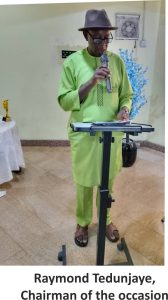 The 2026 Annual Conference of the Association of Maritime Journalists of Nigeria, themed “Attaining Port Efficiency in the Face of Emerging Technology,” became a rare policy summit where the Nigerian Ports Authority, Maritime Police Command, Nigerian Ports Consultative Council, and independent experts publicly aligned on both the diagnosis and the prescription for a sector that handles 90% of Nigeria’s trade.
The Stakes: $19bn, 5% Daily Loss
AMJON President Vera Osopko opened what she called “AMJON’s parliament… where the maritime media sets the agenda for the maritime nation,” with a blunt global comparison. “Artificial Intelligence is clearing cargo in Singapore. Blockchain is tracking containers in Rotterdam. Ghana runs a 24-hour port with one platform,” she said.
Yet UNCTAD data shows 90% of Nigeria’s trade still passes through ports where, according to the World Bank, every day of delay cuts 5% off that trade. The Lagos Chamber of Commerce and Industry puts the annual bill at $19bn lost to inefficiency. “Emerging technology is no longer a conversation for tomorrow. It is the test of today. And Nigeria cannot afford to fail it,” Osopko declared.
She drew the media’s red line: “We will not be cheerleaders for failure. But we will be champions of reform. When you deploy technology that works, we will amplify it. When you install scanners that gather dust, we will ask why.” Her three demands to regulators — “Access to information, respect for the media, and sincerity of purpose” — framed the day’s debates.
The Verdict: ‘Cargo Will Follow Technology’
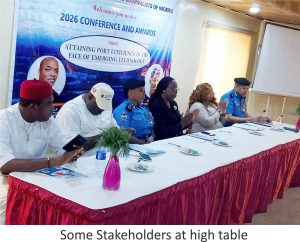 NPCC Chairman Bolaji Sunmola delivered the economic ultimatum. “The era of analogue port management is over. Countries and ports that embrace technology will lead; those that resist will be left behind — and their cargo will follow,” he warned.
Sunmola admitted that high cargo dwell times, opacity in charges, and infrastructure deficits still push business to Lomé, Cotonou, and Tema, making Nigerian ports “among the highest in West Africa” for cost of doing business. But he credited the NPA’s Eto Electronic Call-Up System for restoring order to truck access and praised the National Single Window for “streamlining multi-agency interactions into one digital gateway.”
The next leap, he said, rests on five technologies. First, AI and Big Data for vessel scheduling, berth allocation, and customs risk profiling — “AI eliminates guesswork and significantly reduces the human discretion that often enables corruption.” Second, blockchain for immutable bills of lading and charge schedules to kill document fraud. Third, IoT with smart containers and RFID tags for real-time visibility. Fourth, automated stacking cranes and remote ship-to-shore cranes, with Lekki Deep Sea Port as the “template.” Fifth, AI-powered security — anomaly detection, satellite vessel tracking, and drone surveillance — to deepen NIMASA’s Deep Blue Project.
 His charge to NPA, NIMASA, and the Nigerian Shippers’ Council was direct: “Accelerate digitalisation, enforce compliance with existing technology mandates, and create regulatory incentives for private terminal operators to invest in smart port infrastructure.”
The Blueprint: 8 Indicators, 6 Technologies
Former House member for Apapa, Hon. Muftau Egberongbe, gave the conference its scorecard. “Attaining efficiency at the port in the face of emerging technology is no longer optional but essential,” he said, arguing that “with increasing cargo volumes and larger vessels, traditional manual systems are no longer sufficient.”
He defined port efficiency through eight measurable indicators: vessel turnaround time, cargo dwell time, crane productivity, truck turnaround time, customs clearance speed, cost per container handled, safety records, and environmental performance.
To move those numbers, Egberongbe listed six drivers already reshaping Rotterdam, Singapore and Shanghai: AI, IoT, Blockchain, Automation/Robotics, Digital Twin Technology, and Smart Port Community Systems. For Nigeria, he prescribed seven fixes: port community systems, truck call-up digital systems, customs automation, rail evacuation, smart security surveillance, PPP investment in modern terminals, and staff retraining.
“Ports that embrace innovation will enjoy faster cargo movement, lower operating costs, increased revenue, improved customer confidence, and global competitiveness,” he concluded.
 The Human Cost: ‘ESG Is the Social License’
Dr. Mike Egbayelo, CEO of Excellerate Business School, forced a shift from cranes to communities. “Port host communities are critical stakeholders… yet they often bear disproportionate environmental and social costs of port operations,” he said.
While 80% of global commerce moves via ports, Nigeria’s Apapa, Tin Can, and Onne communities face congestion, pollution, and poor infrastructure. “Despite generating significant revenue, many port communities experience unemployment, poor infrastructure, and limited access to social services,” Egbayelo noted.
His answer was ESG. Environmental: green tech, emission controls, climate-resilient infrastructure. Social: local employment, CSR, community engagement platforms. Governance: transparent reporting, anti-corruption, ESG performance evaluation. “Positive community perception enhances trust and ensures a social license to operate,” he said.
He demanded four policies: establish ESG compliance units, allocate port revenue to host communities, invest in digital systems, and mandate ESG reporting. “Driving prosperity requires a shift to sustainability-driven port management anchored on ESG principles.”
The Security Backbone: 31 Gunboats, CCTV, Water Marshals
DCP Udu Moses Ogechi, speaking for the AIG Maritime Police Command, tied efficiency to safety. “Safety on our waterways is a shared responsibility. Passengers, operators, and communities must adhere strictly to established guidelines,” he said.
He unveiled hard deliverables: 31 gunboats commissioned for Marine Police with advanced navigation and communication systems for real-time patrols. The Lagos CCTV Surveillance Centre, activated January 2026, now monitors the Third Mainland Bridge and adjoining waterways with HD imaging “even beneath the water surface.”
 On regulation, NIWA water marshals now man authorized jetties to enforce mandatory life jackets, while the Inland Waterways Transportation Code has banned unauthorized loading points and mandated vessel identification. Police-Navy collaboration, he said, has deepened intelligence-driven ops against piracy, kidnapping, and armed robbery, with the Navy now training Marine Police personnel.
But challenges remain: “Kidnapping, accidents arising from negligence, and activities of unlicensed operators require not only enforcement but also public cooperation.”
The Government Response: ‘From Potential to Performance’
NPA Managing Director Dr. Abubakar Dantsoho placed the entire debate in the context of AfCFTA. “Port modernization is not merely an infrastructure project—it is a national economic priority,” he said. “Leadership today depends not only on geography, but on efficiency, speed, innovation, and reliability.”
He outlined five reform pillars already underway. Infrastructure: Apapa and Tin Can Island modernization, plus Lekki Port expansion. Digital Transformation: Port Community System and National Single Window to integrate stakeholders and cut delays. Operational Efficiency: faster clearance and shorter dwell time. Connectivity: rail links, inland dry ports, barging, and export corridors. Investment: private sector partnerships for sustainable growth.
The expected outcomes, Dantsoho said, are “faster port operations, lower logistics costs, increased trade volumes, higher government revenue, stronger export competitiveness, more jobs,” and Nigeria’s emergence as “a preferred gateway to West Africa.”
“Nigeria’s ports are moving from outdated systems to modern infrastructure, from delay to efficiency, and from potential to performance,” he affirmed.
The Resolution: One Voice, 7 Demands, 6 Months
By evening, the speeches had fused into one communique. AMJON, NPCC, NPA, Police, and experts resolved that the Federal Government and agencies must within six months:
-Complete full digitalization via a Port Community System linking shipping lines, terminals, Customs, truckers, and regulators.
-Enact a legal framework for blockchain-based e-Bills of Lading to end forgery and unofficial charges, building on Sunmola’s anti-corruption argument.
-Upgrade obsolete cargo equipment to automated stacking cranes and AGVs, using Egberongbe’s Lekki template.
-Mandate ESG compliance units and host community revenue share, as Egbayelo proposed, to secure the social license to operate.
-Develop smart transport corridors with rail evacuation and barging to decongest Apapa, per NPA’s connectivity pillar.
-Create regulatory incentives for private terminals investing in AI, IoT, and digital twins, echoing Sunmola’s call.
-Retrain all port staff on smart tech and benchmark performance against Rotterdam/Singapore using Egberongbe’s eight indicators.
Closing the conference, Ogbuokiri restated the media’s role: “The issues are urgent. The time is now. The media is ready.”
For a sector that loses $19bn a year to delay, the message from Apapa was unanimous: the analogue era is over. The cargo — and the country’s AfCFTA future — will follow technology.