
Felix Mbata, Lagos state
 Hon. Jimoh Olawale Saliu had always been a man of action, but the morning of 30 December 2025 would become a landmark in the annals of Apapa‑Iganmu Local Council Development Area.
According to Hon. Saliu, What we are giving out today is 13,000 food packages, and this is just the beginning.” He spoke of the ticketing system that had been pre‑issued to each household, a method he said was adopted to guarantee accountability, prevent stampedes, and ensure that every hand that reached out would receive a fair share. “I have already dropped copies of the tickets with those in charge and with stakeholders. We don’t want overcrowding. We want the entire process to be orderly and well coordinated,” he added.
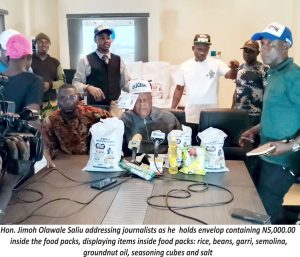
Each food pack, he explained, contained staples that form the backbone of many Nigerian homes: rice, beans, garri, semolina, groundnut oil, seasoning cubes and salt. Tucked inside was an envelope with N5,000 cash, a modest but meaningful boost for families struggling to make ends meet. The chairman’s eyes softened as he described the initiative as “more than a festive palliative.” It was, he said, a response to President Bola Tinubu’s call for leaders to prioritize the welfare of the people. “Our President has consistently encouraged leaders to look for ways to give back to the people. Let every Nigerian have food on their table. That is why we are following this path. During this season, this intervention will assist families across the LCDA,” he declared.
 The story of how this moment came to be was rooted in the first 100 days of Saliu’s tenure. In that brief period, the council had focused on infrastructure—commissioning buses, opening two new roads, and laying the groundwork for development that would benefit generations. But the chairman confessed that the real test of leadership lay in feeding the people. “We concentrated so much on infrastructure during the first 100 days. This time around, we want to concentrate on the human being—what I call stomach infrastructure—alongside health infrastructure,” he said, drawing a vivid picture of a community that could not thrive on bricks alone.
 Funding for the massive relief effort came from savings set aside since his first day in office, a pledge he had made during his campaign. “I intended to do this even during my campaign. I have been saving for this since my first day in office. Just as we save for roads and other programmes, we are also saving to make sure we feed our people. An angry man is an angry man,” he reminded the crowd, eliciting nods of understanding.
The ticketing system, explained Saliu, was the result of community structures—ward chairmen, councillors, youth groups, and landlords—who knew the households in their neighborhoods intimately. “We even did house counting. I am confident that no household in this community has not been captured,” he assured.
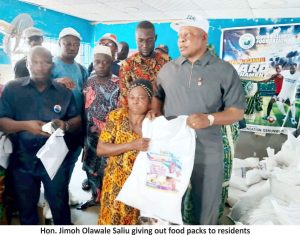
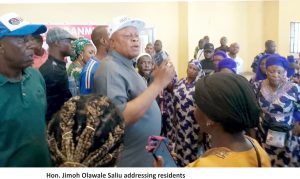 As the line moved, stories began to surface. Mr. Victor Joshua, a native of Cross River State who had made Apapa‑Iganmu his home, stepped forward with a grateful smile. “The food bag is heavy and I am very grateful. This will go a long way in putting smiles on our faces. The chairman promised to assist residents and he has truly fulfilled his promises. I pray God Almighty to bless and preserve him,” he said, his voice trembling with emotion.
Beyond the immediate relief, the chairman outlined a broader vision. The council would continue the food distribution during every major festive period—Ramadan, Easter, and Salah—with plans to increase the number of beneficiaries as demand grew. He also announced that over 1,000 residents who had completed skills‑acquisition training in the first 100 days would receive working equipment in January, targeting tailors, shoemakers, makeup artists, and hairdressers. “We trained over 1,000 people this January, we are giving them equipment. We are also empowering skilled tailors, shoemakers, makeup artists and hairdressers who already have capacity,” he affirmed.
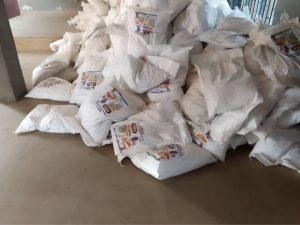 For Hon. Jimoh Olawale Saliu, the day was not just a success in numbers—13,000 packs, 1,000 households, 14 centres—but a validation of a leadership philosophy that places the stomachs of the people at the core of governance.
In the weeks that followed, the story of Ounje Olugbani spread through the wards, becoming a beacon of hope and a reminder that a leader who talks and does can indeed turn the tide for his constituency. As the chairman had promised, the initiative would not be a one‑off event but a recurring pledge, a rhythm of giving that would echo through Apapa‑Iganmu for years to come.