
RAYMOND TEDUNJAYE, Lagos.
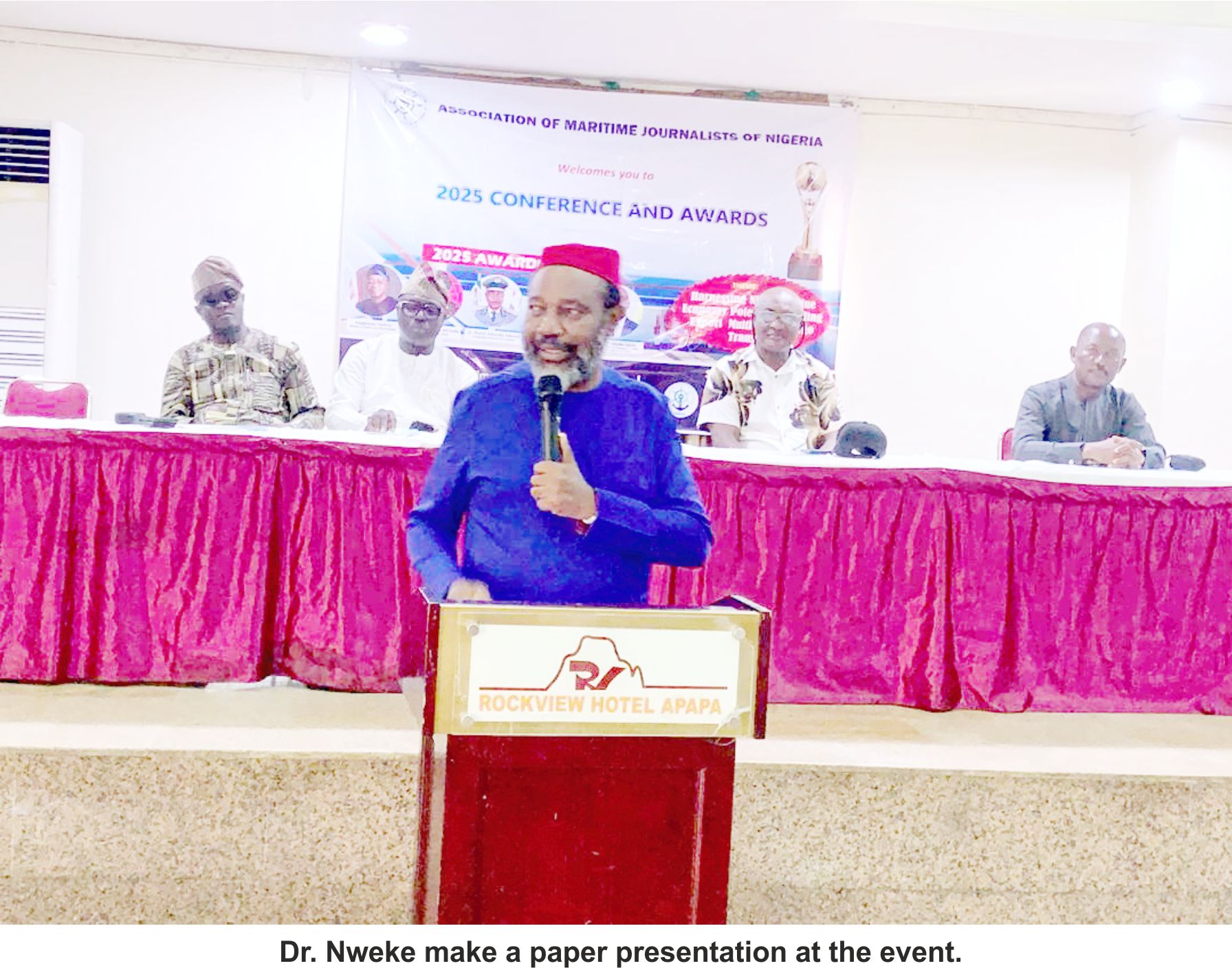
 A renowned researcher and Head of Research at Sea Empowerment and Research Centre (SEREC), Dr. Eugene Nweke, has asserted that the Blue Economy is central to Nigeria’s industrial revival.
Delivering a paper titled “The Essentials of Public-Private Synergy for Optimal Marine and Blue Economy Policy Implementation”, at the 2025 Annual Conference/ Award ceremony of Association of Maritime Journalists of Nigeria (AMJON) in Lagos, Chief Nweke explained that the Blue Economy represents the sustainable use of ocean resources for economic growth, improved livelihoods, and job creation — while preserving marine ecosystem health.
“Globally, it contributes over US$2.5 trillion annually and supports more than 350 million jobs (OECD, 2023). Nigeria, blessed with 853 km of coastline, over 3,000 km of inland waterways, and a 200-nautical-mile Exclusive Economic Zone, is strategically located as West and Central Africa’s maritime gateway.
“Yet, our national contribution to regional maritime GDP remains below 1.5% — a paradox of potential and performance. This underscores the urgent need for Public–Private Synergy (PPS) — a coordinated mechanism that transforms policy frameworks into measurable economic and industrial outcomes,” he stated.
On Conceptual Framing and Understanding Public–Private Synergy, Dr. Nweke noted that PPS extends beyond conventional PPP arrangements, stressing that it embodies a developmental alliance where government, private investors, academia, and communities share responsibility for co-creating, co-financing, and co-monitoring blue economy initiatives.
He pointed out that the public sector provides policy clarity, infrastructure, and regulatory stability while the private sector contributes innovation, efficiency, and finance. Nweke also noted that communities and academia supply local inclusion, sustainability, and human capacity.
He added that the PPS is not just cooperation but a shared governance approach, built on trust, transparency, and technology.
Nweke further highlighted the Blue Economy Pillars and Nigeria’s Untapped Value Chains, disclosing that the Federal Ministry of Marine and Blue Economy has outlined five key pillars for national maritime transformation, including Fisheries and Aquaculture; Shipping, Ports, and Logistics; Tourism and Coastal Infrastructure; Energy and Marine Resources; and Research, Data, and Governance.
On Fisheries and Aquaculture, the maritime expert stated that Nigeria’s fish demand exceeds 3.6 million metric tonnes annually, while domestic production is only 1.5 million tonnes, creating a 2.1 million-tonne deficit worth over US$1 billion in imports. He added that PPPs in aquaculture, cold-chain logistics, and fish processing can bridge this gap and create 500,000 jobs.
With reference to Shipping, Ports, and Logistics, Nweke explained that Nigerian ports handle 70 million metric tonnes of cargo yearly, but operational inefficiencies and weak policy framework make logistics costs 35–40% higher than regional peers. He also mentioned that integrated port automation and multimodal connectivity can save ₦3 trillion annually in trade costs.
Regarding Tourism and Coastal Infrastructure, he disclosed that only 5% of Nigeria’s coastline is harnessed for tourism, emphasising that developing marine leisure and cruise projects can yield US$3 billion annually.
While explaining Energy and Marine Resources, Chief Nweke asserted that offshore gas, renewables, and seabed minerals could add US$10 billion annually if sustainably developed through PPPs.
He further stated that with Research, Data, and Governance, establishing a National Maritime Data Repository (NMDR) will unify sectoral data, strengthen regulation, and support investment forecasting.
Nweke also delved into Steel, Mining and Agriculture (Circular Linkages with the Blue Economy), noting that Nigeria’s vast scrap steel deposits offer a dual opportunity — environmental remediation and industrial rejuvenation.
According to him, when properly integrated into the Blue Economy, this “scrap-to-steel circular chain” can power a new industrial age along Nigeria’s coastal corridor.
On Ship Building and Repairs, he said that locally recycled steel can serve as raw material for hulls, decks, and dry-dock components, reducing import dependence, while Bunkering and Coastal Infrastructure ensures steel fabrication supports safe storage tanks, jetties, barges, and marine engineering works.
Linking this to job creation, Nweke pointed out that a structured national scrap recovery and steel reprocessing system could generate over 200,000 direct and indirect jobs, adding that environmental gains with regulated ship recycling and scrap recovery will curb coastal pollution and unsafe dismantling practices.
“Similarly, linkages with the mining and agricultural sectors can stimulate value-added processing, storage, and export logistics. Locally processed steel can feed agro-machinery fabrication, silos, and processing equipment, boosting Nigeria’s non-oil export base.”
Speaking on Ajaokuta Steel and the National Industrial Backbone, the expert said that beyond recycled materials, Nigeria’s natural steel endowment, anchored by the Ajaokuta Steel Rolling Mill and Itakpe iron ore complex, remains a sleeping giant in the country’s industrial landscape.
“Ajaokuta was originally designed to provide the heavy industrial foundation for shipbuilding, port infrastructure, rail fabrication, and offshore platforms. Decades of neglect, however, have denied Nigeria the full benefits of this strategic asset,” he stated, emphasising that reviving Ajaokuta and aligning its production with Blue Economy objectives will guarantee domestic supply of marine-grade steel for shipyards and coastal engineering projects.
He spotlighted other possibilities, including creating integrated value chains linking mining, metallurgy, shipping, and logistics; enhancing export competitiveness by reducing input costs; and establishing Nigeria as West and Central Africa’s marine fabrication hub.