


RAYMOND TEDUNJAYE, Lagos.
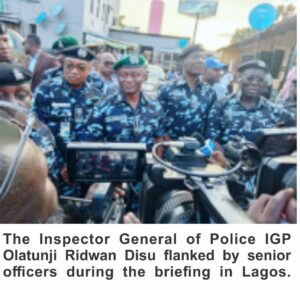 The Inspector General of Police (IGP), Olatunji Ridwan Disu, has expressed concern over delays in the redevelopment of police barracks across Lagos State, saying police officers have been patient for too long and are eager to return to improved accommodation.
Disu spoke with journalists on Saturday 5th September 2026, after inspecting about 21 police barracks and related redevelopment projects across Ikeja and Lagos Island during an assessment tour of the facilities.
The IGP said the condition and progress of the projects were important to the welfare of police personnel, noting that officers require decent accommodation to rest and recover before returning to their demanding duties of protecting lives and property.
He said he was not satisfied with the current stage of development of several of the projects.
“So far so good, I’ve moved around 21 various areas and I am not so happy with the stage they are now. Our officers are eager. They have been patient enough for a lot of times,” Disu said.
According to him, many of the old barracks had been demolished because they had become dangerously dilapidated after years of use. However, the delay in replacing the demolished structures had left officers waiting for new accommodation.
The IGP said his visit was aimed at assessing the projects personally and engaging stakeholders, particularly the Lagos State Government and other strategic partners involved in the redevelopment programme.
Disu also expressed concern over the emergence of shanties and unauthorised businesses on some of the police properties that have remained undeveloped following the demolition of former barracks.
He cited the area around Falomo Police Hospital, where the former barracks had been demolished, saying the vacant space had attracted miscreants.
The IGP said the police would take immediate steps to reclaim its property and remove persons who were not authorised to occupy the land.
He invoked the “broken windows” theory of policing to explain the situation, arguing that neglected properties tend to attract further deterioration and illegal occupation.
“If you leave your property unattended to, others will assist you to damage it more,” Disu said, stressing the need for the police to maintain control of its properties pending redevelopment.
Speaking further, Disu said the welfare of existing residents would also be considered before further demolition takes place.
He explained that residents would be properly documented and provided with relocation allowances to enable them to secure alternative accommodation while construction continues.
He cited the ongoing redevelopment at Ije as an example of the approach being considered.
According to him, about 600 new buildings have already sprung up at Ije after residents were relocated and provided with allowances to move out pending completion of the redevelopment.
The IGP said a similar strategy could be adopted at other large police barracks, including Queen’s Barracks, where new buildings could be constructed on available portions of the property while existing residents remain in other sections.
He said such an approach would enable officers to witness the development of their new homes and build confidence that the properties were being redeveloped for their benefit.
The Police boss, who said he had been IGP for about six months, expressed frustration that the projects had been ongoing for longer than expected.
“I was not happy coming down here because police officers have been patient enough. Now, I’ve now been the IGP for about six months and this thing has been around for more than that,” he said.
He said officers whose barracks had been demolished were looking forward to moving into the new facilities.
Disu said he had earlier hoped that some officers would begin moving into the Ije development by December, but contractors informed him that the project had suffered a further delay of about two months.
He said an agreement reached with the project team indicated that the facilities should become habitable between December and February.
The IGP also promised to maintain regular oversight of the projects, saying he would continue visiting Lagos to monitor progress.
“I’m not going to leave them alone. It’s going to be a usual thing for you to see me in Lagos now to come and see all the projects just like I came now,” he said.
The Lagos State Commissioner for Tourism, Arts and Culture, Toke Benson-Awoyinka, who spoke alongside the IGP, said the Lagos State Government’s partnership with the Nigeria Police Force was designed to address the accommodation and welfare needs of police officers.
Benson-Awoyinka said the initiative began when she served as Special Adviser to the Lagos State Governor on Housing.
She explained that the state government was working with the police to bring private developers and equity investors into the redevelopment of police barracks.
According to her, the state had previously supported the police through the provision of vehicles but decided that accommodation was another critical aspect of police welfare that required attention.
She said the redevelopment programme had experienced delays largely because of the need to obtain vacant possession, conduct headcounts, relocate residents, demolish old structures and prepare the sites for construction.
“At Ije, we finally have full possession,” she said, adding that the project was now moving into full-scale development.
Benson-Awoyinka promised that the state government would work with the police and private developers to deliver 1,000 housing units for police officers at Ije by February next year.
She explained that the redevelopment process had also been complicated by the nature of the sites, particularly swampy terrain that required land reclamation and proper foundation work.
She said the government would not compromise construction standards in its effort to accelerate the projects.
The commissioner said police barracks redevelopment normally takes between 24 and 36 months, but the Lagos projects required additional time because of relocation, demolition, excavation and land reclamation.
She, however, assured that all stakeholders were now working together to accelerate construction and ensure that the long-awaited redevelopment projects are delivered.