


Royal Father at 2026 Cultural Day says school is foundation for saving heritage — Charges parents, tech, and Ezes: “Without language, no tribe”
Felix Mbata, Lagos state
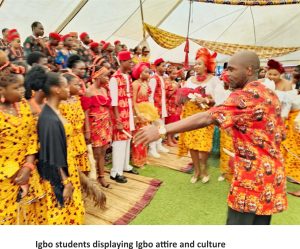
 When His Excellency Eze Ambassador Nicholas Emenike Njoku, Eziokwu bu Ndu I of Abazu, Eze Ohazuru-mee of Ejigbo LCDA and Chairman, Ndi Eze Imo in South West and Diaspora, stepped into Honeyland College, Ipaja on 17th April, 2026 as Royal Father of the school’s Cultural Day themed “One Culture, Our Pride”, he did not come to sit. He came to serve culture.
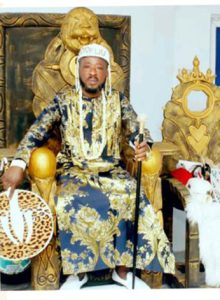 “I feel very glad. I am honoured to be Royal Father today,” he told The Unique Model Magazine. “It means what I am representing about Igbo culture and tradition is noticed by other tribes. I was amazed and happy to be nominated and invited.
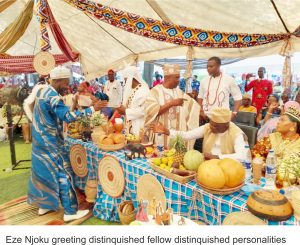 ”But Eze Njoku’s joy quickly turned to action. Already renowned for establishing an Igbo School in Lagos — paying teachers, funding uniforms and running costs from personal resources while building a permanent site — he discovered Honeyland had no Igbo teachers and did not teach Igbo language. His response was immediate: a public request to the school management to integrate Igbo into the curriculum, with a vow to provide and pay the teachers himself.
 “School is the foundation of knowledge. This is where they teach all languages before university,” he said. “Igbo culture and tradition is what I am working for and spending my money and time to establish here in Lagos. This was the right place and time to deliver that message as a Custodian of Igbo Tradition. I will follow it up to ensure that it is done.”
 “THE CHAIRMAN AND MANAGEMENT ARE DOING GREAT WORK”
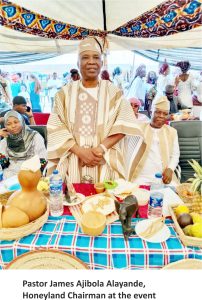
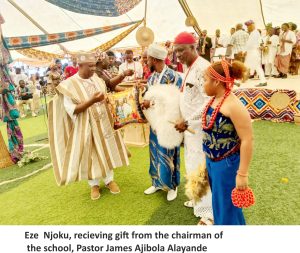
Even as he challenged the school to do more for Igbo language, Eze Njoku was generous in praise for his hosts. “The chairman and the school management are doing great work. I saw different things that day. They have set a standard,” he said. “I advise all participants to continue to support the school to continue to wax strong.”
That balance — commendation plus conviction — defined his Royal Father role. He celebrated Honeyland’s excellence while insisting excellence must include indigenous languages. “One Culture, Our Pride” cannot be complete, he implied, if one of Nigeria’s major cultures is absent from the classroom.
ON YOUTHS, PARENTS, AND “OLD FASHION” CULTURE
 Asked how to convince young people who dismiss tradition as “old fashion,” Eze Njoku agreed with them — then corrected the adults.
“The young ones are 100 percent right to see it that way. When we grew up, our parents told us stories and history. Now parents don’t tell such stories. We are in the computer age,” he noted. “But the basic thing is that we have work to do — the parent work. We must transmit that culture and tradition to our children.”
He added: “The children have the right to feel it is old fashion, but we must make them know they too will become ‘old fashion’ as we are now, in no distant time. So it is our role to establish it in them by practicing our language and dialect at home. They are free to learn other languages in school, but we parents should teach them our language and culture at home. English is for business and relating with other tribes. But once your language is gone, your identity is gone. You are gone.”
 THE LANGUAGE IS FADING — SCHOOLS MUST ACT
Eze Njoku identified Igbo language as the fastest-fading element of culture, citing a UN projection that it could face extinction in 15 years. “That is why I picked up Igbo School. The main key schools need to focus on is the Igbo language. When you speak the language, other things will follow,” he said.
He lamented that Biblical proverbs and parables — traditional teaching tools — “are being kept by the side,” while “politics working through the school is also part of the problem.” His solution: “We the traditional rulers must keep pushing until the children understand. The language is the key and it must start from every home — mother, father, seniors, uncles. We must practice our local languages at home to protect it.”
DRESSING THE PART, PLAYING THE PART
On why he never appears at events without full Ezeship attire, he was clear: “It is not about office dressing. As an Eze, we have roles, reputation, regulations. We have a dress code that gives the Eze distinction. We must represent that name we are bearing.”
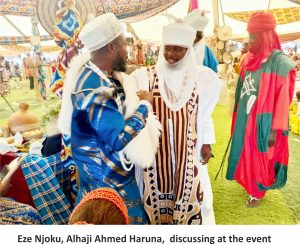 “Many people are looking up to us. Sometimes I am walking on the street, and people who want to know an Eze will easily identify me. So that is why we always represent that name and that position.”
TECHNOLOGY: THE LIFELINE TO DIASPORA CHILDREN
Eze Njoku sees digital platforms as non-negotiable for cultural survival. “Technology has a lot of role to play. I am praying and hoping that God brings money and people that will sponsor the technology part of it, because it will make it easier and faster,” he said.
“There are people in America, Canada, Europe, and Asia who have stayed 10 to 15 years and have not come back to Africa. Their children have no experience of our culture and language. But if they go through global internet teaching — with scheduled days where people will see it — they will learn the language, learn the culture.”
“The only challenge is the financial part, which is very intensive. But it is a must for easy transmission of information.”
CHARGE TO TRIBAL LEADERS: NO LANGUAGE, NO TRIBE
To fellow traditional rulers at the event, his message was blunt: “I charge them to encourage our languages, to ensure that our children take off from us. Without our language, no tribe. Without Hausa language, no Hausa. Igbo, Yoruba — same thing will happen if we allow our language to die. I charge everyone to ensure our languages are striving well for our generation to sustain it to another generation.”
CONCLUSION: ANYWHERE I GO, IGBO CULTURE GOES
Eze Njoku’s appearance at Honeyland College proved one thing: he promotes Igbo culture anywhere he goes — classrooms, palaces, or cultural days. He appreciates excellence, as shown in his commendation of Honeyland’s chairman and management, but he refuses to let appreciation become silence where language is missing.
 From vowing to fund Igbo teachers, to urging parents to speak Igbo at home, to pushing for tech-enabled global classes, his philosophy is simple: culture is kept by action, not applause.
On 17th April, 2026, “One Culture, Our Pride” found a Royal Father who believes pride begins with language. And for Eze Njoku, until Igbo is taught, spoken, and streamed, the work is not done.