

-Federal Government Pledges Innovative, Data-Driven Response to Drug Threat as NDLEA Reports Landmark Interdictions and Rehabilitation Gains
Felix Mbata, Lagos state
 President Bola Ahmed Tinubu has reaffirmed that Nigeria will not relent in the fight against substance abuse and illicit drug trafficking, pledging to confront the menace through evidence-based, innovative interventions anchored on the Renewed Hope Agenda. The President stated this on Friday in Abuja during the grand finale of the 2026 International Day Against Drug Abuse and Illicit Trafficking, where he was represented by the Attorney General of the Federation and Minister of Justice, Prince Lateef Fagbemi, SAN.
Addressing the theme, “The World Drug Problem: Persisting Issues, New Challenges, Innovative Responses,” President Tinubu observed that the evolving nature of narcotics crime demands constant vigilance, adaptability, and collective responsibility. He noted that the damage extends beyond individual users to families, schools, workplaces, and the broader architecture of national security. To counter this, his administration is pursuing a two-pronged strategy: expanding education, skills development, entrepreneurship, employment, and social interventions to reduce youth vulnerability, while simultaneously tightening supply chains through stronger border management, surveillance of ports, airports, and land crossings, improved intelligence, and closer regional and international collaboration.
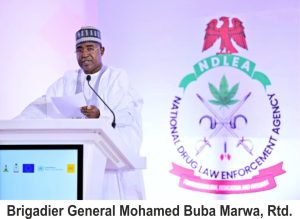
The President stressed that science, technology, and reliable data are now indispensable. He called for stronger forensic laboratories, upgraded technological capacity, and a criminal justice system that can effectively disrupt cartels and hold offenders accountable. He reserved special commendation for the National Drug Law Enforcement Agency and its leadership under Brigadier General Mohamed Buba Marwa, Rtd., CON, OFR, citing increased arrests, seizures, convictions, multi-billion-naira forfeitures, rehabilitation and advocacy campaigns, and the dismantling of organized trafficking networks, including the syndicate behind Nigeria’s largest methamphetamine laboratory. He emphasized, however, that government cannot succeed alone and urged parents, schools, religious and traditional leaders, the media, and the private sector to play their part in prevention, recovery, and job creation.
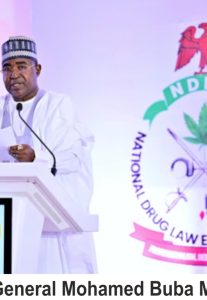
 Presenting the Agency’s scorecard, NDLEA Chairman/Chief Executive, Brig Gen Marwa, said Nigeria stands in lockstep with the global community in confronting a threat to public health, security, stability, and development. He reported that in the last 18 months alone, the Agency arrested 29,262 suspects, seized 5,305,484.88 kilograms of assorted illicit drugs valued at over N1.5 trillion, and secured 5,225 convictions. He described these figures as more than statistics, representing millions of lives saved and billions in criminal wealth denied to traffickers.
Marwa highlighted several breakthroughs, including a transnational operation with the US-DEA and law enforcement authorities from Greece, France, and Switzerland that dismantled the notorious Amadi Simon cartel, and the neutralization of a cross-continental methamphetamine pipeline that led to the arrest of a 63-year-old Nigerian baron, three Mexican nationals, and six Nigerian accomplices. He added that an industrial-scale clandestine meth laboratory was also discovered and destroyed in Tapa village, Ibarapa North LGA, Oyo State, with a Mexican and four others arrested. Over the past five years, he said, 234 drug barons coordinating major networks have been taken into custody.
 Beyond enforcement, Marwa said the Agency has scaled its Drug Demand Reduction efforts through the War Against Drug Abuse campaign, delivering 6,645 sensitization programs in schools, worship centers, workplaces, markets, motor parks, communities, and correctional facilities, reaching nearly five million Nigerians. He also noted that 13,508 persons received counseling, treatment, or rehabilitation in 31 centers nationwide. Aligning with the 2026 focus on innovation, he announced plans to deepen deep-web intelligence, data analytics, and forensic capacity to detect precursor chemicals and new psychoactive substances. He further unveiled Nigeria’s first-in-Africa Alternative Development Programme, which will provide cannabis growers with licit livelihoods through crops such as cassava, maize, cowpeas, and cocoa, in line with the President’s Renewed Hope Agenda.
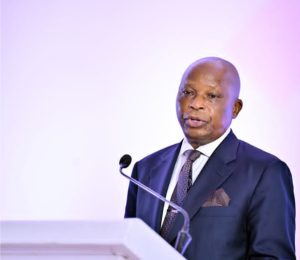 Delivering the guest lecture, “Celebrating Progress and Inspiring Collective Actions against Drug Abuse,” Prof. Oluwatoyin Odeku of the University of Ibadan said the past five years merit celebration because NDLEA’s re-energizing in 2021 has proven the drug war is winnable. The UNODC Country Representative, Chiekh Touré, represented by Dr. Akanidomo Ibanga, commended the balanced approach integrating supply and demand reduction, and reaffirmed UNODC’s commitment to technical support and partnership.
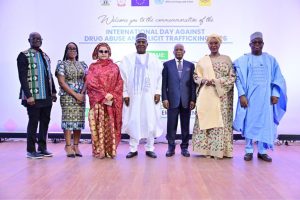
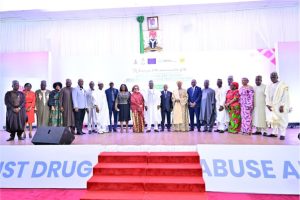
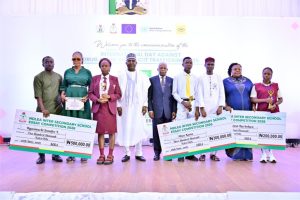 Goodwill messages came from the Senate President, represented by Senator Sadiq Sulaiman Umar; the House of Representatives Committee on Drugs and Narcotics; the First Lady of Kwara State and Chairperson, Nigeria Governors’ Spouses Forum, Amb. Mrs. Olufolake Abdulrasaq; the Coordinating Minister of Health, represented by Mrs. Adeola Olufowobi-Yusuf; the FCTA Health and Environment Mandate Secretary, Dr. Adedolapo Fasawe; the MTN Foundation; as well as representatives of NACA and NAFDAC. A major highlight was the award of N500,000, N300,000, and N200,000 with trophies to the top three winners of the NDLEA inter-secondary school essay competition.
Conclusively, The 2026 observance made clear that Nigeria is moving from rhetoric to results. With presidential backing, NDLEA’s intelligence-led enforcement, rehabilitation expansion, technological upgrades, and a new alternative livelihoods strategy, the country is building a coordinated response that targets both supply and demand. The call to action remains collective: families, communities, institutions, and international partners must sustain the momentum so that the gains recorded today translate into a safer, healthier, and drug-free future for generations to come.
Signed
Femi Babafemi
Director, Media and Advocacy
NDLEA Headquarters, Abuja
Friday, 26th June 2026.